Predicting Vascular Plant Richness in a Heterogeneous Wetland Using Spectral and Textural Features and a Random Forest Algorithm

May 1, 2016·
Julián Cabezas Peña
Julián Cabezas Peña
,
Mauricio Galleguillos
,
Jorge F. Perez-Quezada
· 0 min read
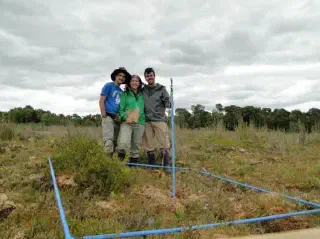
Measuring plant richness in a peatland on Chiloé Island, Chile.
Abstract
A method to predict vascular plant richness using spectral and textural variables in a heterogeneous wetland is presented. Plant richness was measured at 44 sampling plots in a 16-ha anthropogenic peatland. Several spectral indices, first-order statistics (median and standard deviation), and second-order statistics [metrics of a gray-level co-occurrence matrix (GLCM)] were extracted from a Landsat 8 Operational Land Imager image and a Pleiades 1B image. We selected the most important variables for predicting richness using recursive feature elimination and then built a model using random forest regression. The final model was based on only two textural variables obtained from the GLCM and derived from the Landsat 8 image. An accurate predictive capability was reported (R2 = 0.6; RMSE = 1.99 species), highlighting the possibility of obtaining parsimonious models using textural variables. In addition, the results showed that the mid-resolution Landsat 8 image provided better predictors of richness than the high-resolution Pleiades image. This is the first study to generate a model for plant richness in a wetland ecosystem.
Type
Publication
IEEE Geoscience and Remote Sensing Letters. IEEE
publication
Julián Cabezas Peña
Authors
AI and the environment

I am a data scientist and Natural Resources Engineer from Universidad de Chile, with a Master of Data Science from the University of Adelaide. I combine artificial intelligence, data science, statistical analysis and geospatial analysis to tackle environmental challenges.

Since February 2022, I have coordinated the Data Science team at Chile’s Superintendence of the Environment (SMA). I develop automation, data validation and analytical solutions for environmental monitoring and enforcement, using R, Python and SQL.

My experience also includes computer vision and deep learning for agricultural robotics, forest carbon modelling, remote sensing and survey data analysis. I have worked in Chile, Australia and Germany, combining applied research, algorithm development and interdisciplinary team coordination.