Evaluation of impacts of management in an anthropogenic peatland using field and remote sensing data

Sep 1, 2015·
Julián Cabezas Peña
Julián Cabezas Peña
,
Mauricio Galleguillos
,
Ariel Valdés
,
Juan P.Fuentes
,
Cecilia Pérez
,
Jorge F. Perez-Quezada
· 0 min read
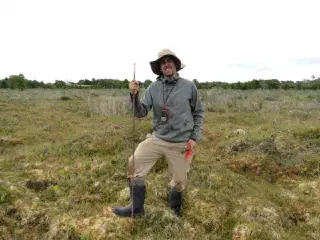
Conducting carbon sampling in the field on Chiloé Island, Chile.
Abstract
Peatlands are a type of wetland characterized by the accumulation of organic matter, called peat, and are important carbon reservoirs. In areas with poor drainage, human‐induced forest fires and logging can produce flooded conditions and organic matter accumulation, which generates an ecosystem called anthropogenic peatland. Productive management activities such as Sphagnum moss harvesting and livestock grazing take place there. Our hypothesis was that productive management has a strong impact on the aboveground C reservoir and increases the presence of exotic species. We established 44 sampling points in a 16‐ha anthropogenic peatland on Chiloé Island, Chile, comparing productive and conservation types of managements. Carbon stocks, vegetation structure and composition variables were quantified. These variables were used to classify the ecosystem into microsites to analyze the different locations in the peatland. In addition, predictive models of aboveground carbon were created using Landsat 8 OLI and Pleiades images. The results revealed a carbon stock of 11.99 ± 0.77 kg C m−2, which is smaller than in natural peatlands, and showed a wide variability of conditions within the peatland itself. This variability, mainly expressed in aboveground carbon, produces microsites dominated by either shrubs, species of the genus Juncus or grasses. Productive management reduced accumulated carbon in the aboveground stock and in the woody debris. However, the strongest impact was found on the vegetation variables, with a decrease in total cover, cover of shrubs and herbaceous plants, and in vegetation height. There was also an increase in the richness and presence of exotic species. The spatial prediction of aboveground carbon yielded significant results using only spectral indices, showing also that the impact of productive management is not homogenous, being less intense in waterlogged areas. This study is the first to quantify carbon reservoirs in this type of ecosystem and to propose variables that can be used as indicators of the impact of human activities.
Type
Publication
Ecosphere. ESA
publication
Julián Cabezas Peña
Authors
AI and the environment

I am a data scientist and Natural Resources Engineer from Universidad de Chile, with a Master of Data Science from the University of Adelaide. I combine artificial intelligence, data science, statistical analysis and geospatial analysis to tackle environmental challenges.

Since February 2022, I have coordinated the Data Science team at Chile’s Superintendence of the Environment (SMA). I develop automation, data validation and analytical solutions for environmental monitoring and enforcement, using R, Python and SQL.

My experience also includes computer vision and deep learning for agricultural robotics, forest carbon modelling, remote sensing and survey data analysis. I have worked in Chile, Australia and Germany, combining applied research, algorithm development and interdisciplinary team coordination.