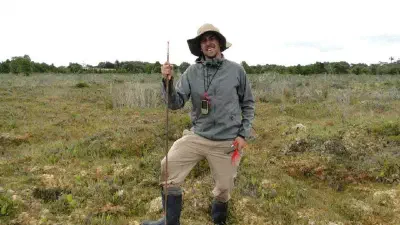
Julián Cabezas Peña

Julián Cabezas Peña

IA y medio ambiente

Soy científico de datos e ingeniero en Recursos Naturales Renovables de la Universidad de Chile, con un Master of Data Science de la University of Adelaide. Integro inteligencia artifical, ciencia de datos, análisis estadístico, y análisis geoespacial para abordar desafíos ambientales.

Desde febrero de 2022 coordino el equipo de Ciencia de Datos de la Superintendencia del Medio Ambiente (SMA). Desarrollo soluciones de automatización, validación de datos y análisis para el seguimiento y la fiscalización ambiental, utilizando R, Python y SQL.

Mi experiencia también incluye computer vision y deep learning para robótica agrícola, modelamiento de carbono forestal, teledetección y análisis de datos de encuestas. He trabajado en Chile, Australia y Alemania, combinando investigación aplicada, desarrollo de algoritmos y coordinación de equipos interdisciplinarios.

Trabajar con un base de datos en .csv o .txt más grande que tu memoria RAM en R utilizando SQLite featured image

Trabajar con un base de datos en .csv o .txt más grande que tu memoria RAM en R utilizando SQLite

¿Cansado del mensaje "out of memory" cuando intentas abrir una base de datos en R?, en este tutorial aprenderás a manejar el poder de SQLite, usando como ejemplo los microdatos del …

avatar
Julián Cabezas Peña
•
Una función para paralelizar en Windows o en servidores (Tutorial paralelizar en R parte 2) featured image

Una función para paralelizar en Windows o en servidores (Tutorial paralelizar en R parte 2)

Una función para crear clusters en Windows, Segunda parte del tutorial "Paralelizando R en Windows"

avatar
Julián Cabezas Peña
•

Paralelizando R en Windows (usando el paquete parallel)

Un pequeño tutorial de como acelerar tus procesos utilizando multiples nucleos en R

avatar
Julián Cabezas Peña
•
Predicting Vascular Plant Richness in a Heterogeneous Wetland Using Spectral and Textural Features and a Random Forest Algorithm featured image

Predicting Vascular Plant Richness in a Heterogeneous Wetland Using Spectral and Textural Features and a Random Forest Algorithm

A method to predict vascular plant richness using spectral and textural variables in a heterogeneous wetland is presented. Plant richness was measured at 44 sampling plots in a …

avatar
Julián Cabezas Peña
•
Reconstructing the vegetation disturbance history of a biodiversity hotspot in central chile using Landsat, Bfast and Landtrendr featured image

Reconstructing the vegetation disturbance history of a biodiversity hotspot in central chile using Landsat, Bfast and Landtrendr

Due to its isolated location, Chile’s flora is characterized by a large number of endemic species which has guided the decision to assign central Chile the status of a global …

avatar
Julián Cabezas Peña
•
How many measurements are needed to estimate accurate daily and annual soil respiration fluxes? Analysis using data from a temperate rainforest featured image

How many measurements are needed to estimate accurate daily and annual soil respiration fluxes? Analysis using data from a temperate rainforest

Making accurate estimations of daily and annual Rs fluxes is key for understanding the carbon cycle process and projecting effects of climate change. In this study we used …

jorge-f.-perez-quezada
•
Evaluation of impacts of management in an anthropogenic peatland using field and remote sensing data featured image

Evaluation of impacts of management in an anthropogenic peatland using field and remote sensing data

Peatlands are a type of wetland characterized by the accumulation of organic matter, called peat, and are important carbon reservoirs. In areas with poor drainage, human‐induced …

avatar
Julián Cabezas Peña
•